
When you hear the siren call to jot down a thought, a story, a memory, why do you hesitate?
Perhaps you don’t have enough time to do it well, to go to that deep place within yourself where you can sort out thoughts and figure out what it is you truly want to say. You know that to get to that interior place, you need time and a physical space with textured silence—a silence that is not a void, but rather a rhythm like the musical trickle of water flowing over stones, or the steady beat of a grandfather clock or even the hum of voices in a coffee shop.
I think this is one of the biggest challenges to writing: finding time and space where you can write.
Some claim that they can write anywhere in any situation, a bustling coffee shop, in an economy seat in an airplane, in the middle of a pedestrian mall, or in bed, as described by Maya Angelo, who kept a hotel room in every town she visited. She never slept in the hotel bed, but instead would lie across it and use it as her writing surface. Or consider Ray Bradbury’s situation early in his career.
With a newborn baby at home, and financial pressure to sell stories, Ray Bradbury sought a calm place where he could concentrate and write. As he was walking around the UCLA campus, he heard the distinct tip-tap of typewriters coming from the basement of the library.
Upon further investigation he found a room, a typewriter room, where a number of students were hunched over typewriters, tapping away. These machines were coin-operated and a dime bought half an hour.
Ray Bradbury sat down and fed in a dime. Then he began to write. He continued for about five hours; every half-hour feeding in another dime. He stayed at it for nine days straight. By the time he was finished, he had spent $9.80, and had written what would later be known as Fahrenheit 451.
In the frenzied atmosphere of that typing room filled with students stressing over looming deadlines, earnestly pressing keys with various levels of ferocity, Ray Bradbury’s focus became laser-sharp and his production enviable. The place he had found was not private but it was anonymous. It was not quiet. Indeed, the commotion of the tapping of the many typewriters created a muffled, textured silence that proved conducive to his writing.
I find it inspiring that Ray Bradbury found a place where he could be productive. He was tenacious. He returned to that typing room every day with a pocketful of dimes until he had accomplished what he set out to do, namely write a story that he could sell.
When I taught writing to high school students, I used to tell them the story about Ray Bradbury and his nine-day relentless focus on writing a story. I’d challenge them to find a place of their own, designate it their special place and go there to write, on a regular basis until they had something that rivaled Ray Bradbury’s efforts.
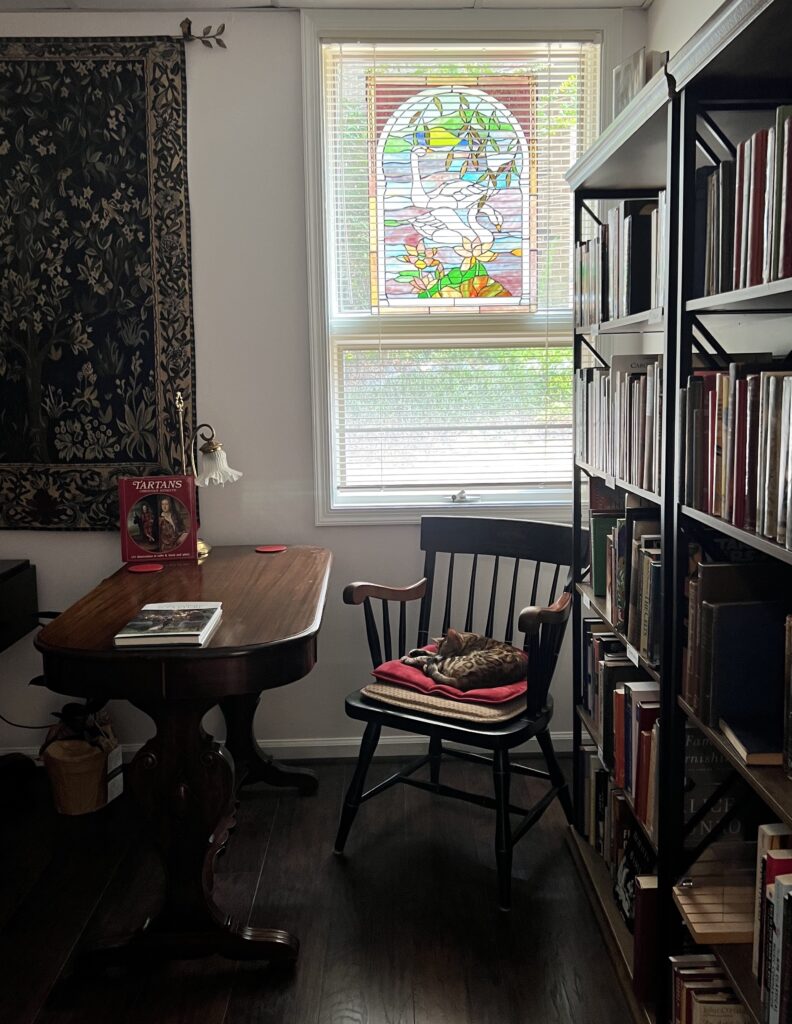
This is what the Writing Corner is all about. A clean, well-lighted place for writers and readers with cosy nooks where writers can come, focus and achieve. It is filled with good books, big and small, all of which have been carefully chosen because they represent the best of the written word.
To write is to express what it means to live fully, to answer that siren call.