
Meripoint Books

Category: From the Editor’s Desk

  • How to Use Prompt Word Patterns to Create an AI Research Assistant

    How to Use Prompt Word Patterns to Create an AI Research Assistant

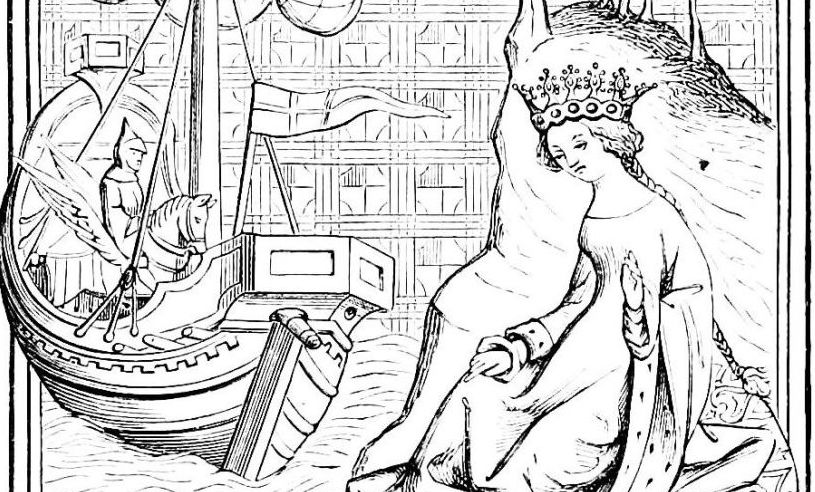
    Graphic of queen hailing a man on a boat

    AI Models Cannot Read Your Mind

    Writers, creative thinkers, we all spend much time and attention in researching our subject and double-checking our facts before publishing our work. For instance, to write my early books on prompt engineering, I spent over three years reading papers, experimenting, making connections, and finally developing a curriculum to teach prompt engineering. 

    In the beginning, I did the research traditionally: identify relevant and timely papers and books, print them out, read, underline, and make notes in the margins. For my latest book, Prompt Engineering Foundations, I turned to generative AI, testing out word patterns and techniques to create generative AI research assistants. I used two models, ChatGPT and Claude for this task.

    Let’s step back for a moment. When people seek an answer from a model, they typically assume that they can just start asking the model questions spontaneously, such as “What foods did people eat during the Gilded Age?” and expect the model to provide accurate and cogent answers. Somehow the model is expected to infer your intentions. The model, however, no matter how advanced or how close to AGI, cannot read your mind. When you give it a general, vague question without context or stating your intentions or task requirements, you’ll get back a neutral, generic answer, which may or may not be helpful.

    If spontaneous questioning is not the best way to use generative AI as a research assistant, what is the correct way?

    It’s very straightforward and begins with carefully considering the task at hand and what it is you hope to achieve, what “experts” you need to accomplish the task, the level of expertise you bring to conversation, and what data the expert should and should not use. You also should have a plan for fact checking any facts that the model gives you. You need to clearly identify how you want the answers to appear and how specific you want the answers to be.

    The machine learning research community has identified word patterns that when included in your prompt, will have various impacts on the output. For instance, to create a specialized AI research assistant that can truly be helpful, relevant word patterns include: Persona, Audience, Reflection, and Fact Check List. The technique, augmented prompting, should also be used to feed the model the information with which you want it to work.

    Let’s look at an example. Here is the context: I am a writer who will be writing about a woman who was born after the end of the Civil War and lived her adult life during the Gilded Age in New York City. I don’t have information about what her day-to-day life looked like or what events might have affected her. I am not a historian and I have never visited New York City. Most of my notions about the era were developed through reading the novels of Edith Wharton.

    What research expert do I need to help me with research? I need to consult with a historian who specializes in that period and place and is known for checking and double checking his/her facts. The expert also needs to have a deep understanding of the social situations surrounding the lives, limitations, and motivations of New Yorkers during that period.

    What output do I want the model to provide? I want short, well-conceived paragraphs with concrete details and references to back up those details.

    To set up the assistant I’ll use the following prompt that incorporates the word patterns mentioned above.

    PROMPT: Please act as an expert historian who specializes in the social history of life in New York City after the end of the Civil War and through the early 1900s. I am not a historian and I have never been to New York City. Everything I know about this period and place is through reading Edith Wharton novels. I am writing a book about a woman who was born after the Civil War and lived a prosperous life throughout the Gilded Age. I have a few details about her, however, I don’t know anything about what her life might have looked like. You will be my research assistant who answers my questions thoughtfully in short paragraphs that include specific details and authentic references for those details.

    ——————————————
    Pattern Key:
    Persona pattern, Audience pattern, Task context, Output format, Reflection pattern

    This is the beginning of what promises to be a fruitful conversation with a model.

    When you initiate a conversation with a well-designed prompt using patterns, the outputs will be better aligned with your intentions and needs. Models still hallucinate and provide inaccurate answers, however, by requesting references and verifying those references and facts before accepting the responses from the model, you can mitigate this limitation.

    Remember also, in conversing with AI models, be clear and specific and define the output that you want. Tell it what your intent is and what you want it to do for you.

    The responses will always mirror your prompts. Use respectful words and it will respond likewise. However, if the model tries to take control of the situation by suggesting a next step, resist the temptation. Stay in control of what the model produces.

    I’ll be happy to answer any questions you might have. Contact me through meripointbooks.com


  • A Place to Write

    When you hear the siren call to jot down a thought, a story, a memory, why do you hesitate?


    Perhaps you don’t have enough time to do it well, to go to that deep place within yourself where you can sort out thoughts and figure out what it is you truly want to say. You know that to get to that interior place, you need time and a physical space with textured silence—a silence that is not a void, but rather a rhythm like the musical trickle of water flowing over stones, or the steady beat of a grandfather clock or even the hum of voices in a coffee shop.

    I think this is one of the biggest challenges to writing: finding time and space where you can write.

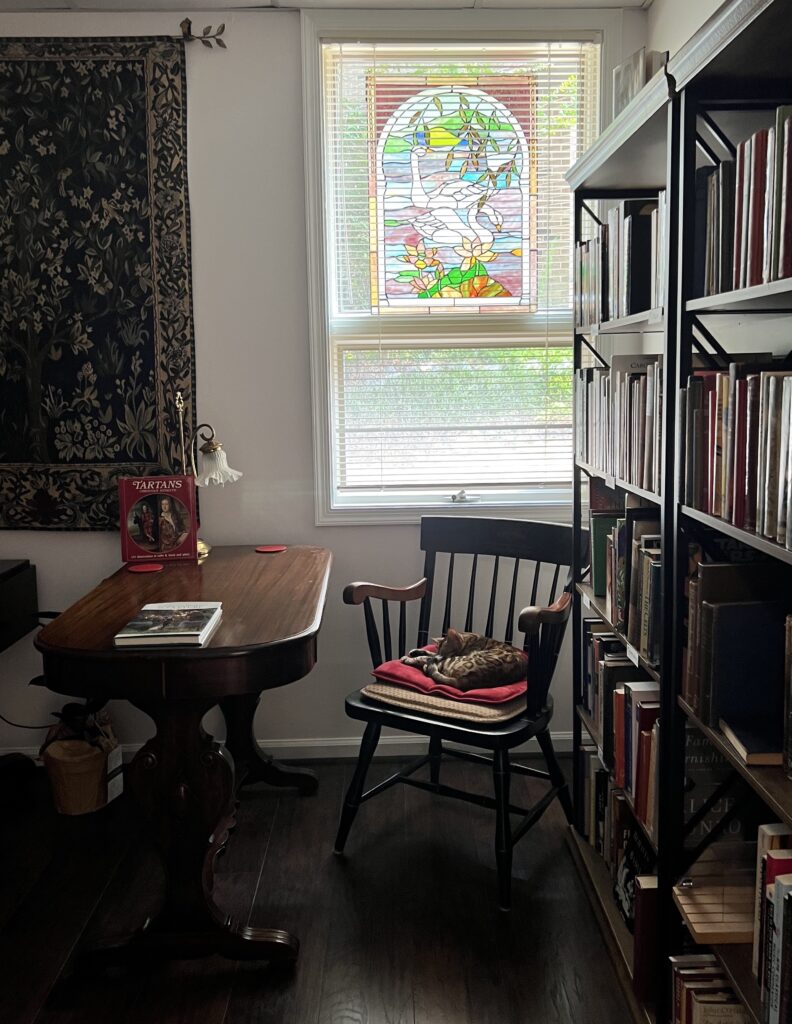
    A room with a chair, a table and books on shelves.
    The Edith Wharton Room of the Writing Corner in Williamsburg.

    Some claim that they can write anywhere in any situation, a bustling coffee shop, in an economy seat in an airplane, in the middle of a pedestrian mall, or in bed, as described by Maya Angelo, who kept a hotel room in every town she visited. She never slept in the hotel bed, but instead would lie across it and use it as her writing surface. Or consider Ray Bradbury’s situation early in his career.

    With a newborn baby at home, and financial pressure to sell stories, Ray Bradbury sought a calm place where he could concentrate and write. As he was walking around the UCLA campus, he heard the distinct tip-tap of typewriters coming from the basement of the library.

    Upon further investigation he found a room, a typewriter room, where a number of students were hunched over typewriters, tapping away. These machines were coin-operated and a dime bought half an hour.

    Ray Bradbury sat down and fed in a dime. Then he began to write. He continued for about five hours; every half-hour feeding in another dime. He stayed at it for nine days straight. By the time he was finished, he had spent $9.80, and had written what would later be known as Fahrenheit 451.

    In the frenzied atmosphere of that typing room filled with students stressing over looming deadlines, earnestly pressing keys with various levels of ferocity, Ray Bradbury’s focus became laser-sharp and his production enviable. The place he had found was not private but it was anonymous. It was not quiet. Indeed, the commotion of the tapping of the many typewriters created a muffled, textured silence that proved conducive to his writing.

    I find it inspiring that Ray Bradbury found a place where he could be productive. He was tenacious. He returned to that typing room every day with a pocketful of dimes until he had accomplished what he set out to do, namely write a story that he could sell.

    When I taught writing to high school students, I used to tell them the story about Ray Bradbury and his nine-day relentless focus on writing a story. I’d challenge them to find a place of their own, designate it their special place and go there to write, on a regular basis until they had something that rivaled Ray Bradbury’s efforts.

    This is what the Writing Corner is all about. A clean, well-lighted place for writers and readers with cosy nooks where writers can come, focus and achieve. It is filled with good books, big and small, all of which have been carefully chosen because they represent the best of the written word.

    To write is to express what it means to live fully, to answer that siren call.

  • Witty Prose and Timeless Banter

    “Jeeves, I said, “stand by to consel and advise. The plot has thickened.”

    “I looked at Jeeves. He looked at me. I did not speak, save with the language of the eyes, but his trained senses enabled him to read my thoughts unerringly.”

    Interior of book.

    “Bertie,” said Aunt Dahlia, “I am a weak woman, but if you won’t tread on this insect and throw the remains outside, I shall have to see what I can do. The most tremendous issues hanging in the balance–our plan of action still to be decided on–every second of priceless importance–and he comes in here, telling us the story of his life. Spink-Bottle, you ghastly goggle-eyed piece of gorgonzola, will you hop it or will you not?

    Back cover of book

    “The shades of evening were beginning to fall pretty freely by now, but the visibility was still good enough to enable me to observe that up the road there was approaching a large, stout, moon-face policeman on a bicycle. And he was, one could see, at peace with all the world. His daily round of tasks may or may not have been completed, but he was obviously off duty for the moment, and his whole attitude was that of a policeman with nothing on his mind but his helmet.”

    The Code of the Woosters

    Our book club read a true classic for last night’s meeting. It was chosen by a member who grew up reading P.G. Wodehouse books. Her family enjoyed lively discussions about the books over the dinner table. She brought with her to the meeting, her mother’s copy of The Code of the Woosters, a Vintage Books edition from the 1970s. It still looked fresh and inviting.

    I think that is one way to describe the world built by P.G. Wodehouse in his nearly one-hundred books that gently satirize upper class life in England, for the most part, post WWI: fresh and inviting. He pulls us into a long-gone zany world and pokes fun at it with vibrant characters who are fantastically ridiculous in an innocent and beguiling way. You can’t help but chuckle throughout it all.

    In the Code of the Woosters, we are immediately thrust into the world of Bertie Wooster, a young aristocrat who is pushed in one direction and then another by well-meaning but misguided pals and aunts. Bertie describes himself thus:

    “It has been well said of Bertram Wooster by those who know him best that there is a certain resilience in his nature that enables him as a general rule to rise on stepping stones of his dead self in te most unfavorable circumstances. It isn’t often that I fail to keep the chin up and the eye sparkling…”

    His man-servant, Jeeves, who is quietly omnipresent and all-knowing, is an invaluable pillar in this world.

    Some of our members had difficulty engaging with the story at the beginning. They had never read Wodehouse before and felt a bit lost. I can understand this, as Wodehouse presumes that his readers are fully immersed in British culture. For those who aren’t anglophiles, it could feel like plunging into cold water. However, after a few chapters, the timeless, universal Wodehouse humor takes effect, and you can’t help but start smiling.

    As one member pointed out, Wodehouse adds sublime, unexpected twists not only to the intricate plot but throughout the narrative and dialogue.

    One member of our club explained that P. G. Wodehouse worked diligently to become a master of the written word and humor. Early in his career after he completed the first draft of a manuscript, he reputedly cut it up into individual sentences and taped each to a wall to examine and change. He was well-known for reworking and revising sentence by sentence until he achieved the right rhythm and humor. He aimed for clarity and precision so that his prose seemed effortless.

    Another member impressed upon us the great influence that Wodehouse has had on humorists and comedians who study his works to form their own brand of humor. Among those who acknowledge his influence are: Stephen Fry (who portrayed Jeeves in the BBC series), Douglas Adams (Hitchhikers Guide to the Galaxy), Terry Pratchett (Author of Discworld novels), and John Cleese (Monty Python and Fawlty Towers).

    Near the end of the discussion, our leader asked, “So, what is the Code of the Woosters?” The answer came quickly: “Never let a pal down” followed by “Don’t put self first”.

    It is indeed, a by-gone world. Happily, we can revisit it any time. After all P.G. Wodehouse left us nearly 100 books of timeless humor to in which to completely immerse oneself.


    Journey’s End, eh, Jeeves?”

    “So I should be disposed to imagine, sir.”

  • How to Get Unstuck Again and Again and Again

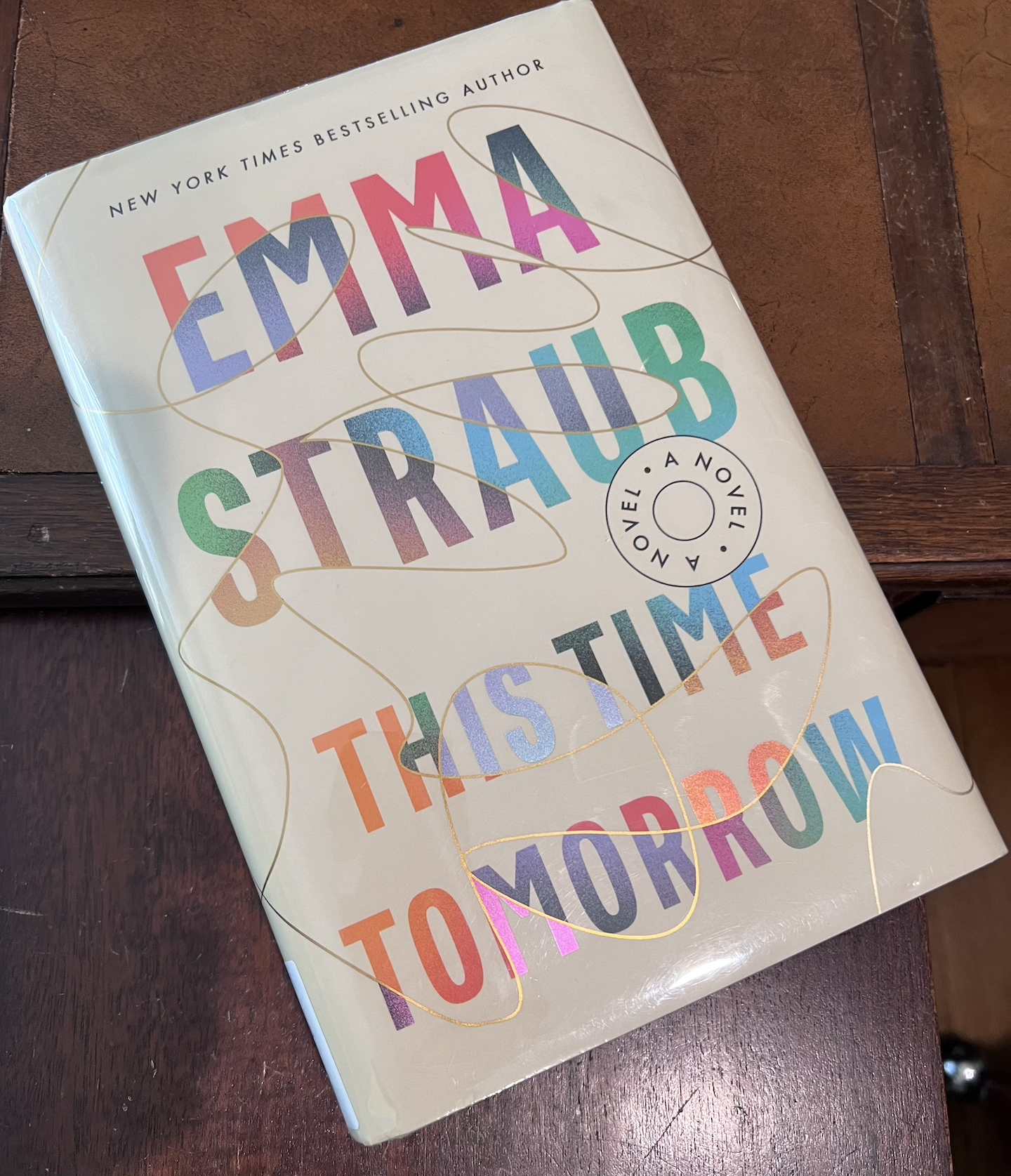
    This Time Tomorrow by Emma Straub (Riverhead Books)

    This month’s book presents us with a character, Alice, about to turn 40. She is a modern New Yorker, single and independent. She has good friends, a steady job, and an apartment within walking distance to her job. Her life is clearly the result of the decisions she has made. She is comfortable. She dines at her favorite restaurants, doesn’t go running because she doesn’t like to. She breaks up with her long-term boyfriend, because, well, just because. She has no responsibilities and no strings attached, except for the situation with her dad, who is lying in a hospital, dying. She visits him every day, weighed down by his impending death.

    When we meet Alice she feels stuck, because she is stuck. She is existing in a stagnant pool of mediocrity. She is aware of this, but she doesn’t have the wherewithal to push herself out of it. Instead of focusing on doing something worthwhile with her life, she decides that she is going to put all of her energies into forestalling her dad’s pending death. The relationship between father, Leonard, and daughter, Alice, is the emotional pivot point upon which this book revolves.

    Alice has grown up in the shadow of her father’s fame; he is the bestselling author of time-travel books. Raised in a sea of this trope, she is taught that time-travel is pure fiction. On her 40th birthday, she tumbles into the discovery that it is real, and suddenly she gains a sense of purpose and agency.

    “It wasn’t just her father that Alice was visiting, it was herself, the two of them together.”

    The reader, previously lulled into the idea that this is going to be a cozy, gentle story about an average woman taking care of her dying dad, is is now thrust into a whirlwind of alternative realities, and is forced to sort out the tangle of time streams.

    So we follow along as Alice teeter-totters between her 16-year-old past self and her 40-year-old present self, which is constantly changing because of the decisions she makes while in her 16-year-old self.

    You have to read the novel in one go. If you put it down for any stretch of time, it will be hard to keep up with her time streams. Time travel stories are always problematic because of the inevitable paradoxes that are difficult to resolve. This novel tries to sidestep the thorniest issues, leaving the reader questioning the plausibility of the tale and the reliability of the narrator.

    Through it all, Alice remains fundamentally, her same stuck, 40-year-old self. We see no growth in 16-year-old Alice, who is in actuality a 40-year-old Alice, who displays no growth either. However, the mutual love shown between father and daughter is heartwarming and carries us along.


  • Absent in the Spring

    “And now, just a special word. No lazy thinking, Joan, my dear! Don’t just accept things at their face value—because it is the easiest way, and because it may save you pain! Life is meant to be lived, not glossed over. And don’t be too pleased with yourself!”


    My favorite sentence: “And suddenly, discordantly, a thought slipped and flashed sideways across the panorama of Joan’s mind, much as she noticed a snake flash and slip in front of the car only yesterday—a mere streak of writhing green, gone almost before you saw it.”

    Life is Meant to Be Lived

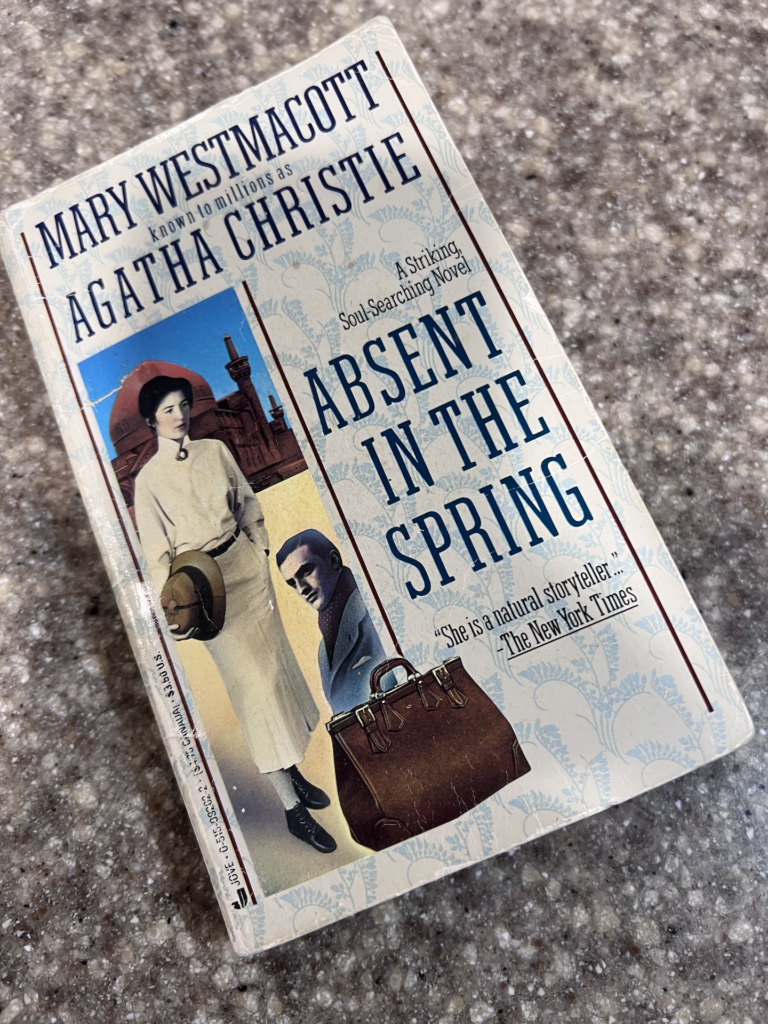
    What does a famous author do, such as Agatha Christie, when she wants the “freedom to explore her most private and precious imaginative garden?” She uses the pseudonym Mary Westmacott. According to Agatha’s daughter, Rosalind Hicks, the six stories written under the Mary Westmacott name were “bitter-sweet stories about love.”

    This month, we are reading the Mary Westmacott book, Absent in the Spring, written in 1944.

    According to Agatha, “I wrote that book in three days flat… I went straight through…I don’t think I have ever been so tired.. I didn’t want to change a word and although I don’t know myself of course what it is really like, it was written as I meant to write it, and that is the proudest joy an author can have.”

    It is “the one book that I had always wanted to write, that had been clear in my mind. It was the picture of a woman with a complete image of herself, of what she was, but about which she was completely mistaken. Through her own actions, her own feelings and thoughts, this would be revealed to the reader. She would be, as it were, continually meeting herself, not recognizing herself, but becoming increasingly uneasy. What brought about this revelation would be the fact that for the first time in her life she was alone—completely alone—for four or five days.” (Family memories from www.agathachristie.com)

    Fast forward eighty years to our current year 2024. Can the modern reader relate?

    It is not a happy story and does not give anyone a warm feeling that all is right in the world. The characters are not terribly likable. However, it is a believable story—a story that leaves one thinking, ‘but for the grace of God, go I.” The main character, Joan, though appearing outwardly critical of everything that doesn’t measure up to her standards, has developed a coherent inner moral compass, thoroughly consistent with upper-middle class British values and social norms, that guides her actions and interactions with others. Yet to maintain this stiff-upper lip attitude, she has created a reality all her own.

    The first two sentences of the novel are revelatory:

    “Joan Scudamore screwed up her eyes as she peered across the dimness of the Resthouse dining room. She was slightly shortsighted.”

    She lives life with blinders on. She doesn’t peer too far into the distance or too deeply into the abyss.

    While reading the story, one wants to take Joan by the shoulders and shake her to wake her up. But as the author points out, we encounter her during the only time in her life when she is completely alone. And it is fascinating how solitude has given her a rare opportunity to peal back the layers of self-deception to slowly uncover the reality of her relationships with her husband and children.

    I think the modern reader will react strongly to this story depending on where they are in life. It may serve as a precautionary tale, or it may cause extreme self-reflection regarding one’s own relationships with those whom they love. It is depressive and frustrating because as a reader, we know more than what Joan knows, and we want her to stop stifling her thoughts that are revealing important truths about her life. Nonetheless, it is hard to put down. Will this experience change her life? Who amongst us will allow a miraculous event to change our fundamental direction in life?

    i

  • Innovative Memoirs

    How Does One Write About One’s Life?


    Whenever I meet two people in love, I typically ask them: How did you meet? It’s incredible the many different ways there are to meet a future significant other. For instance, my darling and I met outside just before a dramatic lightning storm. Who would have guessed? But this isn’t unusual as all of the stories I have heard are in their own ways unique and illuminating.

    Innovative Memoirs. We have stories to tell about our lives—leaving home for the first time, the best birthday present ever, a pilgrimage. The question is do we keep these experiences close to our hearts and relay them haphazardly to only those in our midsts—rendering them forever as a fleeting story once heard, details forgotten. Or do we capture these important memories on paper to give them a permanence and stature so that by purpose or chance, others can be enlightened by them?

    A written memoir is a soulful piece of art: a place where one carefully curates those moments most precious. I think we’d all agree that writing down one’s stories is invaluable. The only stumbling block? You have to sit down and write.

    For the time-crunched amongst us, tools have popped up to make writing memoirs easier. You can find various apps and services that will send you a periodic email or text with a question such as “Who was your best friend growing up?” You only have to type up or dictate the answer in a reply, and send it back to the service. There is little commitment and no forethought required. After a year or so of such back and forths, the service will organize your responses in book form and send you a hardcopy of your ‘memoir.’ Is this really the best way to preserve your memories?

    I believe we can be more creative with memorializing our treasured experiences. We can take control of how our life is documented and have fun doing so. For instance, we can dramatize our lives in the form of a novel, or give a chronological presentation of the important events in our lives. We can create collections of letters written to a future generation. We can create collections of short stories or quotes or fun facts. We can tell our stories in illustrations with little bubble captions of narrative.

    One bold author gives us a beautiful example of a memoir expressed in graphic novel format. Cartoonist Sophia Glock tells the story of her childhood in Passport (published by Little, Brown Ink, 2021) which describes the author’s upbringing as a child of two American spies living in foreign countries. Panel by panel, illustration by illustration, we learn of the difficulties and conflicts of her childhood lived in the shadows. Using a gentle three-color palette, the author draws the reader in with artistry and just the right amount of narrative, giving us a glimpse of her unique life experiences. It is a beautiful example of innovative memoir.

    I challenge you, dear reader, to think about how you, too, can capture your memories on paper and put them into innovative physical form.

    “…I think comics were perfect for a memoir about adolescence because everything when we’re adolescents is visceral and immediate. So I felt it was a good match.” (Sophia Glock, NPR interview, 2021)

    Our Meripoint kitty enjoys Passport.


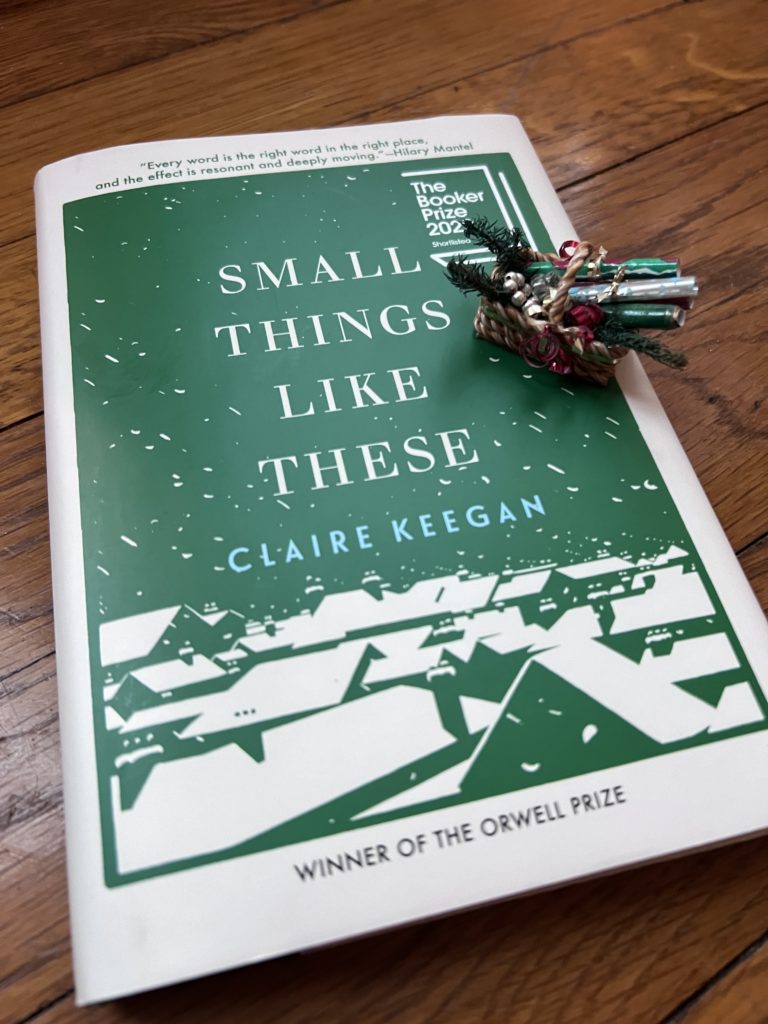
  • Small Things Like These

    “Before going back into the house, he’d washed his face at the horse-trough, breaking the ice on the surface, pushing his hands down deep in the cold and keeping them there, to divert his pain, until he could no longer feel it.” Small Things Like These by Claire Keegan

    Chilling Times

    Note to self: if you go to Ireland in the winter, bring an extra pair of boots.

    From the very beginning of Small Things Like These, we know this is going to be a cold novella. It is beautifully written and expertly crafted so that every page chills the holiday spirit. Consider: “And then the nights came on and the frosts took hold again, and blades of cold slid under doors and cut the knees of those who still knelt to say the rosary.” Many readers will see this as a novel of hope and courage, others may not. Set during the Christmas season in a small, economically-depressed Irish town in the 1980s, it features a middle-aged self-made man, Bill Furlong.

    Furlong is a coal merchant who is getting by. He is married to the woman he loves; he is proud of his five daughters, all of whom are excelling in the best school in town. He acknowledges the good life he has built, yet worries that he will lose it all. His thoughts from the start are depressive. Here is our hero, a few nights before Christmas after attempting a conversation with his wife: “Not for the first time, Furlong felt that he was poor company for her, that he seldom made a long night shorter.”

    Furlong is in a sulky, reflective mood. His work is hard and unrelenting. His wife doesn’t want to hear about the “small things” that are important to him such as giving away his last bit of change, or going out of his way to help someone who needs a ride. He is concerned for his children and thinks: “They could be like young witches sometimes, his daughters, with their black hair and sharp eyes.” This gloomy melancholy oozes in and out of the cold arches of the story.

    Why is he in such a funk? I believe he qualifies as a man in a mid-life crisis — one expects to see a sports car suddenly appear in his driveway. After all, Furlong is weary from the monotonous rush and smallness of his life. He can’t stop thinking about his past — and the unfortunate realities of it. He was raised in a rich woman’s home, a housekeeper’s bastard son. We hear of many details: his mother’s low station, his outcast standing, his ignorance of his father’s identity, etc.

    As he wanders farther down the path of nostalgia, his unease with his current life grows and he searches for an alternative path. “For a time he stood listening and looking down at the town, at the smoke starting up from the chimneys and the small, diminishing stars in the sky. One of the brightest fell while he was standing there, leaving a streak like a chalk mark on a board for just a second before it vanished. Another seemed to burn out and slowly fade.”

    This novella doesn’t have the length necessary to explore the fullness of the situation it beautifully presents in the first half of the story.  In the second half, the author has taken shortcuts and has failed to provide critical scenes. Consequently, the second half feels contrived; too many coincidences occur. Furlong wanders around the convent (why?), stumbles into girls scrubbing a chapel floor and later finds one of those girls in the coal shed. It isn’t clear why she is there — the reader has to fill in the back story.  The girl asks him to help her find her baby and/or escape. While Furlong ponders the encounter, a nun appears, reclaims the girl, and invites him in to tea. During the course of this tea, an unattractive, machismo, side of him emerges: “He sat on, encouraged by this queer new power. He was, after all, a man amongst women here.”

    Leaving the convent, he continues to ruminate over the girl, but now with a different spirit. He doesn’t discuss her with his wife or a trusted friend or try to find a legitimate way to help her. Rather, without a clear understanding of her situation, he internalizes what he imagines her plight is and begins to liken her fate with that of his mother. It is now Christmas Eve, he plods through hours, visiting destinations of his life, receiving warnings in every direction he turns. “For a while, he simply walked along the quayside with his hands deep in his pockets, thinking over what he’d been told and watching the river flowing darkly along, drinking the snow.” All the while, he is building up courage to act. He wants to get the girl away from the convent. However, he knows that doing so will risk the well-being of his business, his marriage, and his daughters’ futures. Will he trade the life that he worked hard to achieve for the chance at being a hero in his own heart?

    “It would be the easiest thing in the world to lose everything, Furlong knew.”

    (FYI: the narrator demonstrates bias against Catholicism, e.g. jabbing sentences and metaphors such as slicing the knees off of the faithful praying the rosary, likening destructive crows to nuns, spiking the convent.)

    A favorite sentence:

    “Magically, then, the streets seemed to change and come alive under the long strands of multi-colored bulbs which swayed, pleasantly, in the wind above their heads.”


  • Good Night Avant-garde, Sleep Well

    Good Morning Innovative Lit!


    Innovative Literature. What does this mean? Something new, something that pushes the boundaries of what we consider literature? Yes.

    We used to say avant-garde when referring to trailblazing artists. It was a glamorous term, evoking twentieth-century images of highly intelligent, misunderstood yet beautiful people alone in their convictions, together in their desire to overthrow everything traditional, all of society if possible. Yes, they created rule-breaking, establishment-crushing works that shook the pillars of their world. Think Picasso, Andy Warhol, Bela Bartok! Their visions and creations shattered customary notions of beauty. They stridently lit fires to destroy before creating. They shocked; they provoked; they remained unapologetic for their messes.

    Yet today, their works hang placidly in museums, gazed upon affectionately or even worse, as comfortably classic, like Grandpa’s pipe. Occasionally they may make a splash when the price tags they command go public.

    The same can be said for literature. The works of avant-garde authors such as Gertrude Stein, Vladimir Nabokov, and Virginia Woolf which once punched holes into the walls of convention are today acknowledged as great classics. They reside in the dusty confines of our literary canon, drifting in endless circles over the twentieth century.

    We must live where we are. Today we seek innovative rather than avant-garde. With innovation, we get exuberant energy and intelligence and much of what the old term avant-garde suggests, but we don’t ascribe to a zero-sum outlook.

    Innovative literature attempts to lift up our awareness by bringing something delightfully crisp to the table without causing hurt. We don’t need to tear down social structures. We build bridges. There’s much good that can be done by working together.  We get new ideas, new concepts of character and place. We get whiffs of whimsy infused in perspectives that don’t take themselves too seriously yet offer a new sense of what it means to be human.

    And what does innovative literature look like? Many, especially academics, might point you in the direction of online platforms where you can read electronic literature using links and special effects that guide you through interactive experiences. It is fascinating. But this is not what is meant by innovative literature.

    First, ground rules. Innovative literature must be available in a physical form that can be put in a bookshelf. It must endure in ways that electronic literature can never endure. Therefore it must be producible in hard copy form, i.e. paperback or hardcover book.

    Second, it must bring something novel to the literary shelves. Virginia Woolf’s contribution to literature was an entirely new narrative perspective. The poet ee cummings gave us unique uses of punctuation in poetry, hence his name is often uncapitalized and without punctuation. Mary Shelley introduced science fiction with Frankenstein. And so on. Innovative literature may offer a new genre, a new perspective, a new way of telling a story. What might this look like today?

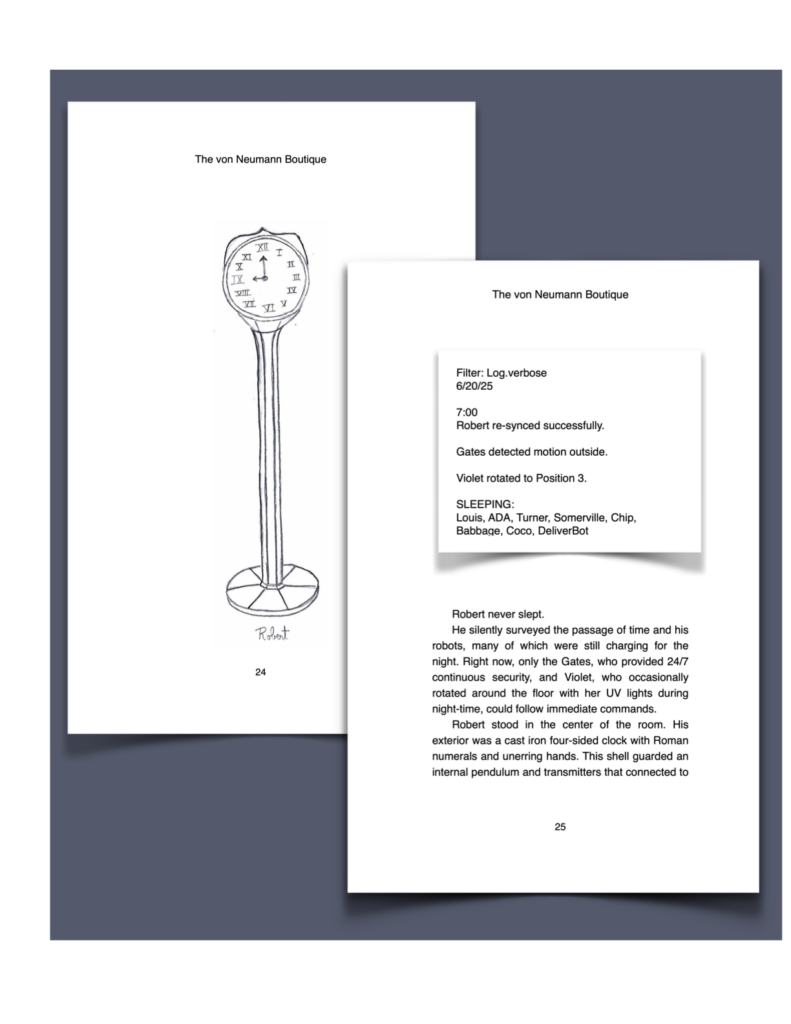
    Consider The von Neumann Boutique, an innovative novel written in 2020 by Anneliese Brei when she was an undergraduate. It has a futuristic setting when robots are individual automatons, fully integrated in society. They interact with one another and with their human customers. The plot, based loosely on an event in the life of Ada Lovelace, revolves around the personalities of the robots, their fears, hopes, limitations, and dreams. The robots access great stores of data and make autonomous decisions to function in a human-centric society.

    The originality of this novel begins with the narrative form. The narrator is “Logcat” who breaks into the story via a log record when major processing events with one or more of the robots occur. Thus, the reader is witness to both the drama amongst the robots and the parallel processing going on behind the scenes. To add to the dimensionality of the story, hand-drawn illustrations  of the characters and the processing framework are interwoven throughout the novel. Altogether, these elements are a new and imaginative way to tell a story.

    Readers, writers — this is a glimpse of innovative literature!

    In The von Neumann Boutique, the main characters are robots such as Robert, pictured above, left. The narrator is Logcat who breaks into the story as messages with processing status updates, right.


    “I can’t do it,” ADA said to Turner… “I can’t follow their requests with logic. Today I tried using one of my buggy circuits. It seemed to give me more creative answers. But then everything cross-wired again. Human customers! I’m going insane!”

  • The New Frontier of AI

    Writers, Behold!


    Generative AI has exploded upon the writing scene. We can’t ignore it.

    I remember clearly the moment the large language model known as ChatGPT (Chattie in our household) entered my life. My twenty-something daughter was wandering around the family room carrying her open laptop. She meandered over to me and said, “Hey Mom! Look at this!”

    I peered into her laptop screen, expecting a video or an interesting photo. Instead all I saw was a white void with small boxes around phrases such as “Tell me a fun fact” near the bottom of the screen. Under that was a blinking cursor waiting for input. “It can write stories!” my daughter said. “What do you want it to write?”

    I peered at a prompt line at the very bottom of the screen. “Tell it to write a story about a little girl with curly brown hair who lived in a castle. She typed it in.

    Oh my gosh! Within seconds, an entertaining story unfolded before our eyes. It was eerily similar to the make-believe stories my husband used to tell my daughter at bedtime. It had believable characters, a simple plot, and a satisfactory ending. I said to my daughter in a very serious tone, “Why do I even bother to write?”

    Why write, indeed! Yes, the AIs are getting better and better every day. I know because I use Chattie all the time. I have tested it up and down and right and left. Over the last year, I have seen the models improve significantly. And I have read many dire predictions about the impact this might have on our society as a whole. This technological advance gives us much to process. Before jumping to fearful conclusions, I think we should first understand the nature of this beast.

    At a rudimentary level Chattie is only a highly sophisticated statistical “predict the next word” black box. It has been fed an unimaginably large compendium of written works composed by human beings and found on the internet. The result is a multi-dimensional highly complex “map” of words where like is placed with like, or words that are most likely to go together are placed together. The black box is then “trained” by applying a mathematical equation with billions of parameters. Once trained, Chattie knows how to respond to a prompt.

    When we give Chattie a prompt of one or more sentences, it traverses its map of words and finds strings of words that are most likely to go with our original sentences. This “answer” may look intelligently derived, but it is not. Chattie has no intentionality. It’s simply a sophisticated pattern-matcher— a brilliant machine-learning application. It is not equivalent in any degree to someone who has a vision and makes decisions, such as a writer.

    We writers have been graced with the great need to express our thoughts and emotions by putting words on paper, massaging them, sculpting them. We are motivated by desire and a sense of mission. We have something unique that we want to say, that we must say. It is our soul that sings out whenever we put pen to paper or fingertips to keyboard. It is our heart that cries with joy when inspiration arrives and we can say, “Well said!”

    Chattie has neither heart nor soul. It is simply a computational tool that produces strings of words that make sense. We as writers can embrace this technology by finding ways in which it makes our lives easier. For instance, it is a great research tool. I can ask Chattie any question about a well-known event or person, subject, etc., and it provides answers. If I don’t understand a concept, I can ask Chattie to explain it to me; what a great personalized tutor! Exploring the capabilities of Chattie is pure fun.

    Yes, we should use this technology wisely. Even more importantly, we should try to get a foot into the door of the natural language processing labs that are producing large language models. Wouldn’t it be dandy if we could give the researchers pointers about AI tools that would be particularly useful to those who are experts in using words?

    We can’t ignore generative AI. Let’s embrace it.

    Generative A.I. circa 2023, DALL-E 3 and the Editor at work.


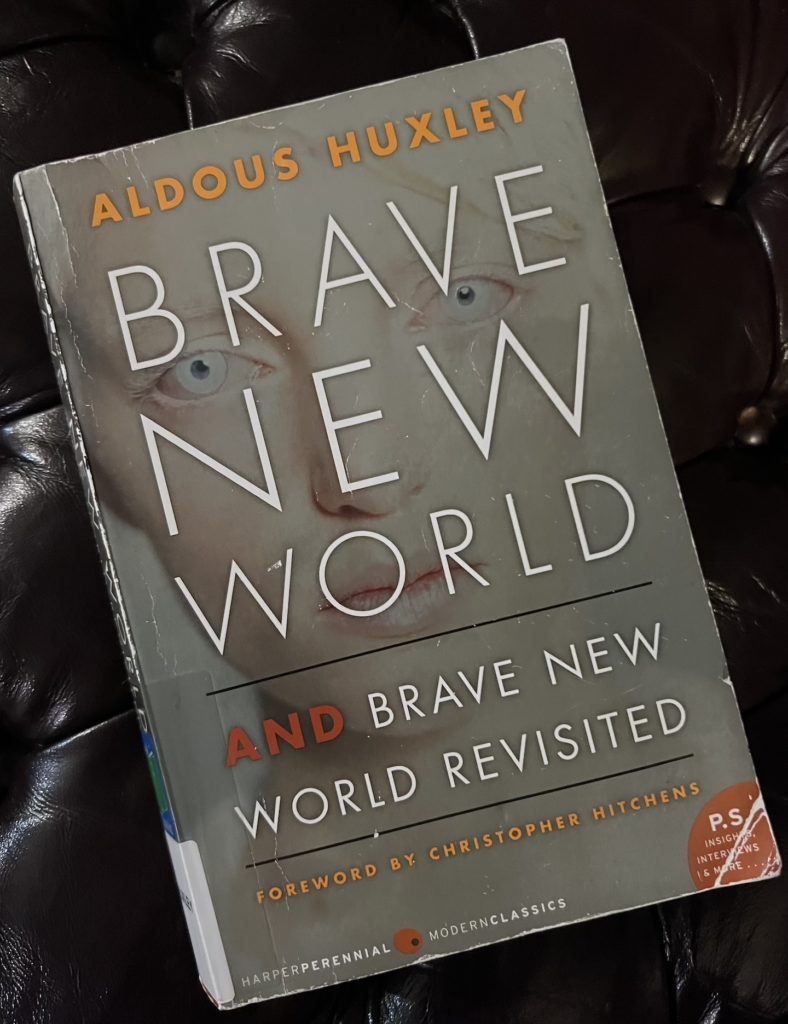
  • Brave New World by Aldous Huxley

    “It suddenly struck me the other day that it might be possible to be an adult all the time.”


    Every once in a while, a book club should read a classic dystopian novel.

    Planetary Motto: Community, Identity, Stability

    Have you ever wondered what a rational, engineered civilization would look like? One that prioritizes the happiness of its citizens above all? One where “there isn’t any serious need for a civilized man to bear anything that’s seriously unpleasant?” Where people are “adults intellectually and during waking hours, [however] infants where feeling and desire are concerned?” This is a curious thought-experiment; one that Aldus Huxley explores in Brave New World.

    “History is bunk!” “Ending is better than mending.” These are two of the multitude of slogans that the civilized people of Brave New World are brainwashed into believing. No one questions or seeks the purpose of life. After all, “happiness is the sovereign good.” The citizens remain in a perpetual state of infantile adulthood where sexual promiscuity, regular drug use, extreme sports, exaggerated entertainment, and wanton consumption are not only encouraged by society, but are expected, if not required.

    In this engineered world, eugenic science and technology are taken to the limit to create five castes of humans ranging from Alphas with superior human intelligence down to Epsilons with no human intelligence (“the lower the caste, the shorter the oxygen”). The Alphas are the leaders and intellectuals of the society whereas the lower castes are consigned to menial labor. This is a world of social slavery absolutes. Everyone is conditioned from bottle-birth (no human female involved) to adulthood to be content to do the jobs assigned to them. In their leisure hours, they are compelled to seek hedonistic pleasures.

    It is bad to be alone. Therefore nothing is private. “Everyone belongs to everyone else.” There are no exclusive relationships, no families, no marriages, no children to raise. All activities are communal. Conflicts that arise are quickly snuffed out by a poof of soma, an idealized drug that puts people into a state of paradise.

    Poof, and freedom is forever out of reach. Pleasurable slavery at the expense of art, science, philosophy and religion. As the Controller for Western Europe further explains, “We’ve got youth and prosperity right up to the end. What follows? Evidently that we can be independent of God…God isn’t compatible with machinery and scientific medicine and happiness. That’s why I have to keep these books locked up in the safe…People would be shocked.”

    There are no books! Why do dystopias always deprive their citizens of books? Consider 1984 and Fahrenheit 451.

    If we could plunk ourselves down into this Brave New World, just for a little bit, how might we react? Huxley has given us a hint. He takes a young man, John the Savage, who was born and raised outside of civilization, and thrusts him into this sensually-fulsome world. At first, John is patient and cooperates by trying to understand his experiences through the filter of Shakespeare. He falls in love with an Alpha woman. However, despite his efforts, his values are in constant clash with all that he sees. He wants to change this world, make it more human, more fallible. But they won’t let him. And they won’t let him return to his native land either. He is trapped. Do you think this is going to end well?

    What are we to make of this mess? Why read it? Truly it is a precautionary tale.


    My favorite sentence:

    “Some men are almost rhinoceroses. They don’t respond properly to conditioning.’”